Every winter, Nagato Yumoto Onsen — said to be the oldest hot spring town in Yamaguchi Prefecture — is lit for the Utaakari Festival. For seven weeks the whole town is wrapped in gentle verse and lantern light.
In winter, the Utaakari Festival takes place along the Otozure River, which runs through the hot spring town of Nagato Yumoto Onsen. The festival takes its theme from the poems of Misuzu Kaneko, a children’s poet born in Nagato City.
Its centrepiece is the Utaakari Gento Rondo, a performance of shadow images that moves with a narration of her poems, together with thousands of Akari no Utsuwa — lantern vessels made by schoolchildren from across the city and set out around the town. It is the winter tradition of Nagato Yumoto Onsen, and we hope you will come and see it.
Nagato Yumoto Onsen Machi Co., Ltd.
Essentials
Dates
15 January – 7 March 2027
Hours
Sunset to 10 p.m., daily
Admission
Free
Where
Along the Otozure River in Nagato Yumoto Onsen, Nagato City, Yamaguchi
Prefecture — centred on Onto hot spring and Gangi Square, the Bamboo Grove Steps and the
riverside park
Some parts of the programme may change in bad weather.
The Eight Areas
Eight areas, each with plenty to see
① Gento Rondo
Bamboo Grove Steps — Onto & Gangi Square
Shadow images dance to a narration of Misuzu Kaneko’s poems — the theme of the festival — set to music. The lighting of the bamboo grove around it and of the square changes with them: an entertainment of sound and light.
② Misuzu’s Garden
Onto & the Lawn Square
With the help of nurseries, kindergartens and primary and secondary schools across Nagato City, some 2,400 children made lantern motifs. Thousands of lights, on the theme of three of Misuzu Kaneko’s poems, give visitors a warm welcome.
③ The Fishes’ Dream
Beside the Bamboo Grove Steps
Beside the bamboo grove steps, lantern vessels are laid out in the shape of a great fish. Look for the work of the city’s nursery and kindergarten children, rising out of a deep blue sea.
④ Tsuchi-Akari — Lights of Clay
Gangi Square, in front of Onto
Close to Nagato Yumoto Onsen, in the Sonose district, the Fukawa-Hagi kilns have been making Hagi ware for some 360 years. With the help of their potters, children from a local primary school made Hagi ware lampshades, which light the night with a warm glow.
⑤ Wreaths at the Water’s Edge
Gangi Square — Riverside Park
Large lantern motifs, made in workshops over the years mainly by people of the Yumoto area, are set along the Otozure River. Their slow flicker rises on the surface of the water and makes a scene out of a dream.
⑥ The Misuzu Mosaic Mural
engawa YUMOTO
The whole wall of engawa YUMOTO carries a large mosaic mural of Misuzu Kaneko, lit softly for the festival. Step close to see the craft of the mosaic.
⑦ The Little Birds’ Steps
In front of Daigo Nagaya
On the theme of Misuzu Kaneko’s poem Origami Asobi (“Paper-Folding Play”), small origami lanterns are lit. Look for the warm light of the paper cranes, folded as a wish for peace and happiness.
⑧ The Train of Light Maze
Otozure Riverside Park
The bonds that the JR Mine Line has built between the towns along it are expressed here as a “train of light” pointing to the future, with children from Mine City taking part.
Misuzu Kaneko
The poet whose words are the theme of Utaakari
Misuzu Kaneko and Nagato City
The children’s poet who loved the nature of Nagato
Photo courtesy of 金子みすゞ著作保存会 (Kaneko Misuzu Chosaku Hozonkai)
Misuzu Kaneko was a children’s poet from Nagato City, active from the end of the Taisho era into the early years of Showa, and is remembered for poems of quiet, arresting beauty. Her short life produced more than 500 of them, and the landscapes of her birthplace appear in them again and again — the mark of someone who loved that plain and generous countryside deeply.
In Senzaki, in Nagato City, the Misuzu Kaneko Memorial Museum stands on the site of Kaneko Bun’eido, the bookshop where she spent her childhood. It holds a permanent exhibition of her manuscripts and personal effects, a research room, and a gallery where her poems can be experienced through sound and light.
Misuzu Kaneko Memorial Museum: 1308 Senzaki, Nagato City, Yamaguchi Prefecture Official site (Japanese) >
About Nagato City
Nagato City sits on the north-western coast of Yamaguchi Prefecture: a place of rich countryside, a beautiful coastline and hot springs. Motonosumi Shrine, where 123 red torii gates run along the cliffs above the Sea of Japan, and Omijima Island, a quasi-national park best seen from a sightseeing boat, are among the views that draw people here.
There is also Senzaki, a port town for fresh seafood and for the yakitori Nagato is known for, and Nagato Yumoto Onsen, the renovated hot spring town. Nagato City is waiting, with its four seasons and a warm welcome.
Aerial footage, and the festival introduced by its lighting designer
Nagato Yumoto Onsen
Said to be the oldest hot spring town in the prefecture, made new
Nagato Yumoto Onsen has some 600 years of history behind it and is said to be the oldest hot spring town in Yamaguchi Prefecture. A tourism and townscape plan is under way here, and the town now has Onto — the original bathhouse, rebuilt in a modern design by younger people from the area — along with places to eat local food, stepping stones and the Kawadoko River Terrace beside the clear Otozure River, and lighting that turns the streets luminous after dark.
A town built on the idea of OSOTO — living outdoors
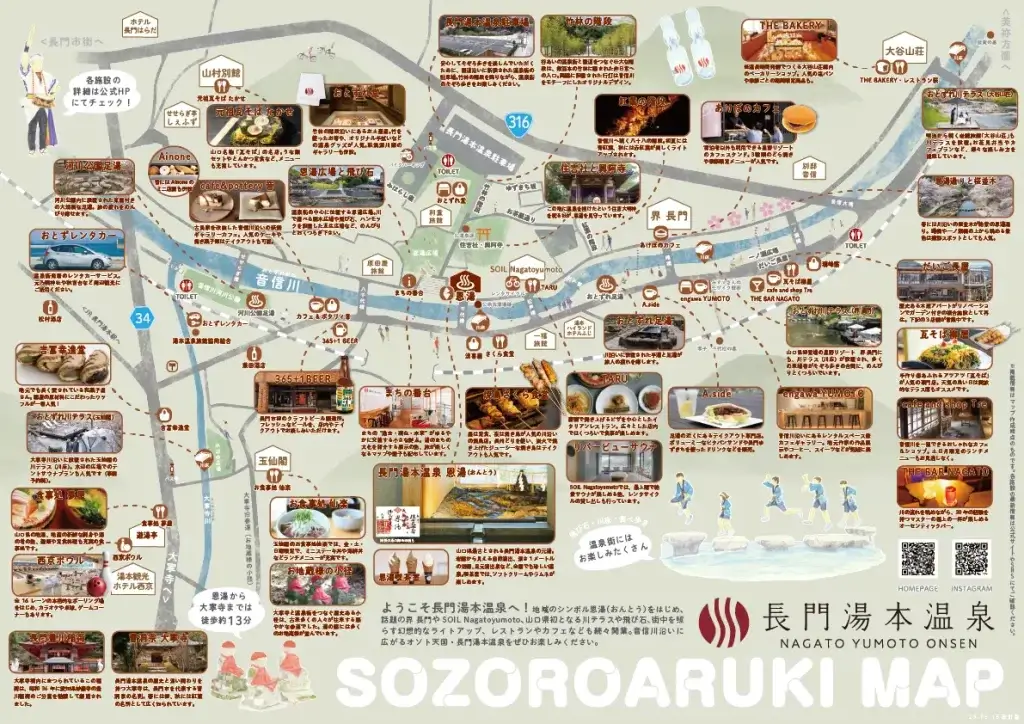
A hot spring town rich in nature, with places to eat and shops dotted along the clear Otozure River. Take the OSOTO map in hand and enjoy an unhurried stroll.
A few things to keep in mind, so that everyone can enjoy it
Lighting hours
The lights are on every day of the festival, from sunset until 10 p.m. Parts of the programme may change in bad weather.
Parking
Please do not park on the streets along the river. Use the Nagato Yumoto Onsen car park on the main road. Parking information (Japanese) >
Keep warm
Winter nights in the hot spring town are very cold. A heavy coat and a scarf are a good idea. Onto, the public bath at the centre of the festival site, is a fine place to warm up.
Take your rubbish with you
In early summer, fireflies appear along the river. That is looked after by the people who live here. Please take cigarette ends and rubbish home with you.
Getting here
The festival site is in Nagato Yumoto Onsen, in the north-west of Yamaguchi Prefecture.
From Fukuoka by highway bus — the “OTOZURE” bus runs from Hakata and Tenjin in Fukuoka to Nagato Yumoto Onsen with no transfers. All seats are reserved, so book in advance — you can do it in English: how to book the “OTOZURE” bus.
By local bus — buses on the JR Mine Line route call at “Nagato Yumoto Onsen (Nagato-Yumoto Station)”, in the car park
on the main road, within walking distance of the festival site. Please check the current timetable
before you travel.
By car — please use the Nagato Yumoto Onsen car park on the main road
(paid). Parking along the river in the town is not permitted.